A Diminisher or a Multiplier?

Yes, that’s what people in leadership roles can prove to be.

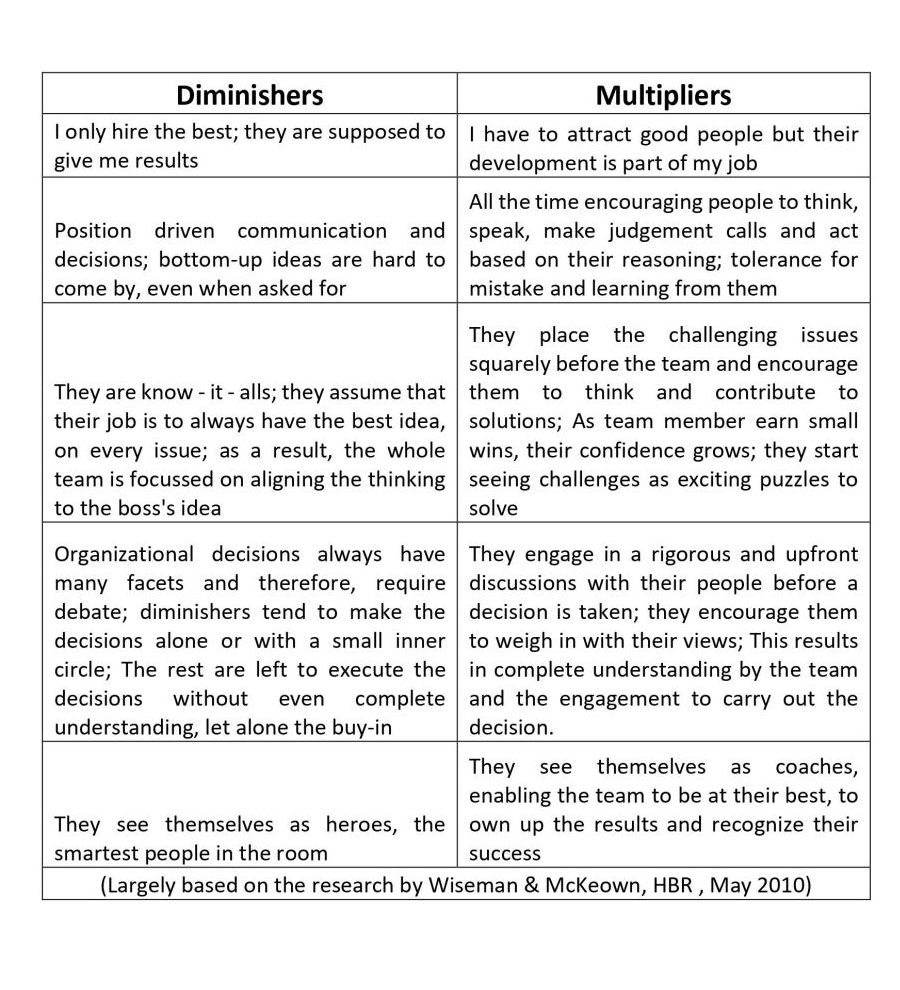
Researches (Wiseman & McKeown, HBR , May 2010)  point out that effective leaders gain from their team as much as 2X of what their ineffective counterparts do.

So what are some of the major differences between the two? Please see the attached document.

Which end of the spectrum are you at? Are you working to progress towards the multiplier end?

Important questions to reflect on for the leaders. Take help, if required.
#executivecoaching #leaders #leadership #effectiveness


Similar Posts

  • Why Leadership Programs Don’t Deliver and What to Do about it?

    Leadership excellence is known to strongly correlate with organizational excellence. A notable example is the intervention carried out by Sears, Roebuck & Co published in #HBR in January 1998 (“Employee-Customer-Profit Chain at Sears”). The investment on leadership development projected to hit $81 billion globally in 2024, reflects this belief. Yet, Gallup data and DDI | Development Dimensions International ’s report on leadership…

  • |

    The Enterprise World

    The Enterprise World, a global business magazines featured Performance Enablers as one of the 10 most reliable HR Solution providers in India. Please click on the links for details.Read More

  • The Executive Team and Organizational Resilience

    I have written in this space about the significance of an executive team, aligned on the values and vision of an organization. How it facilitates culture building, synergy and sustainable growth. After all, an enabling culture is the most important and sustainable source of competitive advantage for an organization.  As so many of you have…

  • The People Factor

    Here is a short piece on employee engagement based on Gallup (2023) report. The People FactorAn under-leveraged opportunity It’s a foregone conclusion that a fully engaged workforce is a major source of competitive advantage for an #organisation . Unfortunately, only a small proportion of global #workforce is engaged. Gallup (2023) study puts it at 23%. (Incidentally, the figure is higher at…

  • Focus at the top

    Let’s look at some of the major issues almost every organization is trying to come to terms with.1. Strategic agility, to cope with the changing customer demands / market conditions.2. Fully engaged workforce, aligned with the vision and strategy3. Cross-functional synergies and so on.Organizations are investing enormous resources to develop these capabilities. It’s my hypothesis…